I don't know if anybody in Hollywood read my web pages on NUMB3RS. If they did, then they didn't tell me about it. But all my issues have been addressed in the first two episodes of Season Two. These two shows have regained the spirit of the pilot that had me so upbeat about "NUMB3RS."
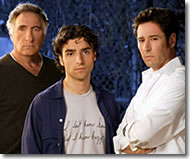
Holy shit!
The math insights on the show are
genuine, legitimate, honest mathematical issues.
They also fit my show
conditions
of being useful, non-obvious, and accessible.
Example One:
Charlie points out that the circumstances of a decision
can be deduced from the decision itself.
Under what conditions would a decision be the
right decision?
He calls this "reverse decision theory"
and it is a nice piece of mathematical insight
which is
useful, non-obvious, and accessible.
Example Two:
A radio car key has an ever-changing signaling sequence
that opens the car door.
The sequence itself isn't going to identify the car
but the changes in the sequence as the button is repeatedly pressed
gives information about the make and model of the car.
Here I have a harder time believing the FBI wouldn't already
know how to identify a car from its radio key,
but the insight is definitely
useful, non-obvious, and accessible
mathematics.
Charlie's attitude is a 180° reversal
from the cocky, I'm-smarter-than-you posture presented last year.
He portrays his mathematical craft as guidance
rather than instant certainty.
When he simplifies and orders a large
(not "exponential," just "more")
stack of suspect files,
he offers a reasonable explanation of his contribution.
"My system is not meant
to be a replacement for your skills,
simply a tool to help you
use them more effectively."
Thank you, Charlie, for saying
what I have been trying to explain for two decades.
When the intuition of others conflicts with
his mathematical conclusions,
he likens his insights to a partial fingerprint,
evidence to be weighed.
Last year's Charlie would have insisted that his analysis
trumps the judgment of experts because it's mathematical.
I even liked the point where Charlie says,
"Sometimes math does something we can't explain.
My analysis says he's still a suspect."
I have done analyses whose results were not what I expected
and, occasionally, I have no direct, causal explanation
for what I found.
Sometimes the result is just a combination of factors
that intuition isn't enough to see directly.
In real life (at least in my life)
the end of these stories is often that the math
gives us new insight and new intuition.
Why not have that happen on television, too?
I enjoy the development of the show's characters as people
even if the obsession with dating is one-dimensional.
It gives them a chance to interact in a setting
other than the immediate drama of crime solving.
The emphasis on math was smothering the show last year.
I feel it's now-smaller role makes it more interesting
and more believable to the viewing audience.
Charlie isn't the only expert,
even his father contributes expertise
by recognizing that a sequence of numbers is football scores.
The plots are basic, TV-drama formula.
I happen to think that's a good thing [1]
because the viewer can concentrate on
the unusual crime and the interesting math that solves it
rather than wondering what plot twist is coming next.
When somebody is looking over Charlie's shoulder at something,
the viewer expects that person to have something to add
that Charlie himself may not have known or did not see.
That makes the show predictable in one sense
and interesting in another.
The
episode guide
has me worried.
The third show
"Obsession"
seems to have Charlie become a handwriting-analysis expert,
something lacking in my own mathematical education.
In the middle of the first season,
Charlie became an instant expert on everything.
I was particularly distressed when he could look
at a phony ten-dollar bill and figure out who drew it.
This is an area of subject-matter expertise
where a mathematician has no advantage
over any generally-smart person.
The scripts clearly need a going-over by a real mathematician,
preferably one who has taught mathematics.
(If they already have such a person,
then he needs to spend more time doing his job
or they need another person.)
Charlie's definition of "exponential" is awful [2]
and his explanation of "Bayesian" is too vague.
I want this show to succeed in the right ways.
After all,
Hollywood is glorifying my own craft in my own time,
a challenge it has aggressively avoided in the last two decades.
I'm excited about it and I'm glad the show survived long enough
to have another chance.
On the other hand,
I feel we mathematicians in particular,
and techno-geeks in general,
should be watchful that what we do is portrayed
in an insightful and reasonably honest way.
"NUMB3RS" ran out of steam after the first few episodes last year.
Let's hope insight and honesty have more staying power
this time around.
1.
Having a formulaic structure for the show gives it shape and form,
a scaffolding for the more-interesting math and crime stories.
It gives writers and viewers a plot framework.
A Wrinkle in Time by Madeleine L'Engle
contains one of the most beautiful descriptions of human life.
Mrs. Whatsit compares life to a sonnet:
"It is a very strict form of poetry is it not?
"There are fourteen lines, I believe, all in iambic pentameter. That's
a very strict rhythm or meter, yes?
"And each line has to end with a rigid rhyme pattern. And if the poet
does not do it exactly this way, it is not a sonnet, is it?"
Calvin: "You mean you're comparing our lives to a sonnet? A strict
form, but freedom within it?"
"Yes. You're given the form, but you have to write the sonnet
yourself. What you say is completely up to you."
19:23:45 Mountain Standard Time
(MST).
8373 visits to this web page.